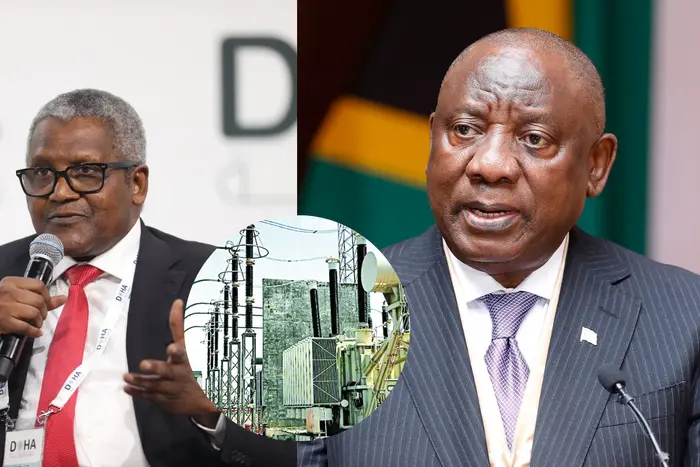
Africa’s richest man, Aliko Dangote, and South African President Cyril Ramaphosa have highlighted high interest rates, currency instability and project bankability as major obstacles to financing power projects across the continent.
The two leaders discussed the challenges during a panel session on infrastructure financing and renewable energy development, examining why African power projects continue to struggle to attract sufficient funding despite the availability of capital in local markets.
Ramaphosa argued that significant funds are available within African economies, but projects must be properly structured and financially viable to attract investors and lenders.
“Our experience has been that the money is there in the local market,” Ramaphosa said, noting that a substantial portion of financing for renewable energy projects in South Africa had come from domestic sources.
He stressed that the key issue was the “bankability” of projects, adding that well-structured projects capable of generating returns could secure funding from local financial institutions.
Dangote, however, pointed to the high cost of borrowing as a major constraint, arguing that the availability of money does not necessarily translate into affordable financing.
“Yes, there is money in the local banks. But if you really look at it, the interest rates are high,” he said.
He also warned against borrowing in foreign currencies to finance projects that generate revenue in unstable local currencies, saying exchange-rate fluctuations could expose investors to significant losses.
Dangote advocated greater use of local currency financing to reduce foreign exchange risks, arguing that investors should be able to commit local funds before converting them into foreign currency where necessary.
“If I’m going to invest in Nigeria, I would like to put my Naira first and then buy dollars so that I have to risk that currency exchange rate,” he said.
The discussion underscored the need for governments, banks and investors to create financing structures that can make energy projects more attractive while reducing currency and interest-rate risks.
Dangote also linked improved electricity supply to broader economic growth, saying countries that significantly expand their power generation could create more jobs, strengthen businesses and increase government revenues.
“Wherever you go and double your power, even your internally generated funds, that’s government revenue, will increase, because you will now put a lot of people at work,” he said.
The exchange between Dangote and Ramaphosa highlights a critical challenge facing Africa’s development: the continent has enormous energy needs and investment opportunities, but high financing costs, currency volatility and difficulties in structuring bankable projects continue to constrain investment.
With millions of Africans still lacking reliable access to electricity, closing the continent’s power gap remains a major priority for economic growth, industrialisation and job creation.