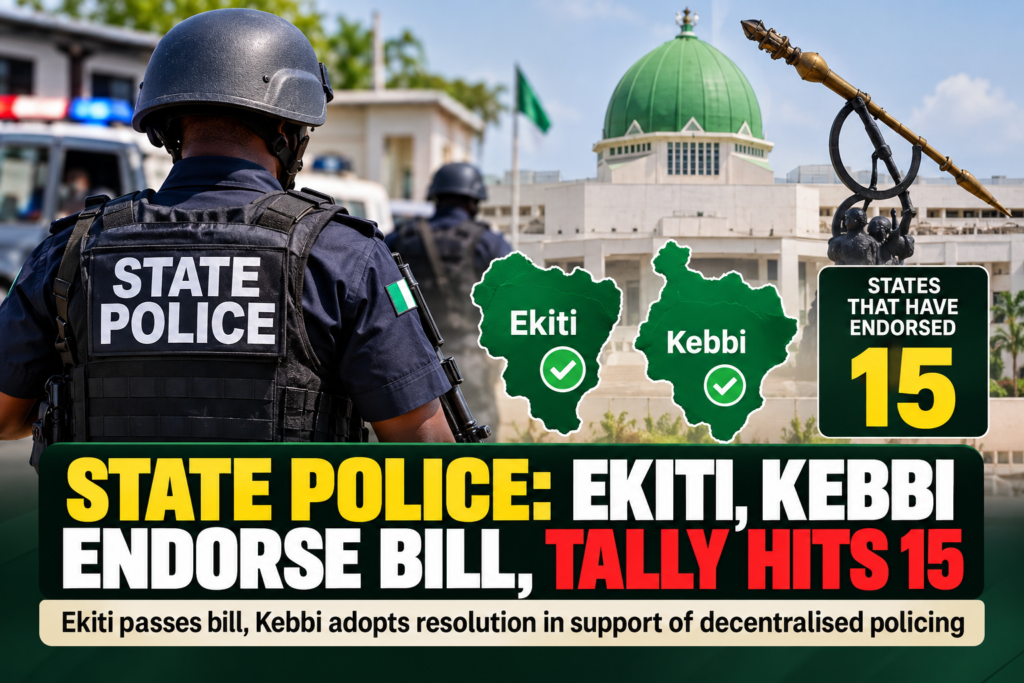
ABUJA, Nigeria — The push for the establishment of state police in Nigeria has gained momentum as the Ekiti and Kebbi State Houses of Assembly have endorsed the proposed constitutional amendment, bringing the number of supporting states to 15.
While Ekiti lawmakers passed the Constitution of the Federal Republic of Nigeria, 1999 (Sixth Alteration) Bill, 2026, Kebbi lawmakers adopted a resolution backing decentralised policing as part of efforts to address the country’s security challenges.
The latest endorsements follow similar approvals by 13 states: Osun, Edo, Oyo, Rivers, Zamfara, Kwara, Nasarawa, Ogun, Delta, Taraba, Cross River, Plateau and Enugu.
Under the constitutional amendment process, at least 24 of Nigeria’s 36 state Houses of Assembly must support the proposal, representing a two-thirds majority.
In Kebbi, 20 lawmakers endorsed the proposal during Wednesday’s plenary, presided over by the Speaker, Salihu Dangoje. Four members of the 24-member Assembly were reportedly absent on official assignments.
The resolution followed deliberations on a proposal presented by the Chairman of the House Committee on Internal Security, Muhammad Garba Bena.
Bena said the proposed state police system would strengthen security operations, improve responses to threats and enhance the protection of lives and property.
He explained that the arrangement would empower state governments to establish their own police services and recruit personnel in accordance with constitutional provisions.
“The establishment of state police will go a long way in strengthening security operations, improving responses to security threats and protecting lives and property in Kebbi State and Nigeria at large,” he said.
The Speaker subsequently announced the Assembly’s adoption of the resolution in support of state police.
In Ekiti, the Assembly passed the bill on Wednesday, with all 21 members present supporting the proposed constitutional amendment.
The Chairman of the House Committee on Media and Public Affairs, Babatunde Oke, disclosed this in a statement issued in Ado Ekiti.
According to Oke, Speaker Adeoye Aribasoye directed the Clerk of the House to transmit the approved document, alongside the legislature’s observations, to the National Assembly.
Aribasoye described the proposal as a major national issue that had remained at the forefront of public discourse for more than two decades.
He said Nigeria’s security challenges required practical and responsive solutions, citing concerns over delayed responses to distress calls, limited operational reach and the distance between law enforcement agencies and the communities they serve.
The Speaker noted that insecurity had continued to threaten livelihoods, disrupt education, weaken business confidence and undermine public trust in some parts of the country.
He argued that a properly structured state police system could improve accountability by bringing policing leadership and oversight closer to citizens and their elected representatives, provided adequate constitutional safeguards were established.
Aribasoye maintained that the country could not afford unnecessary delays in addressing its security challenges, describing state police as a practical necessity rather than a theoretical option.
Oke further disclosed that the Assembly’s Committee of the Whole House had examined the proposed amendment clause by clause and recommended concurrence, subject to an amendment to Section 317A(5).
With Ekiti and Kebbi joining the list of supporting states, the proposal has secured 15 endorsements, leaving it nine states short of the 24-state threshold required for the constitutional amendment to advance.
The growing support reflects increasing calls for a decentralised policing structure that would enable states to respond more effectively to local security threats, although the proposed framework must still satisfy the constitutional amendment requirements.