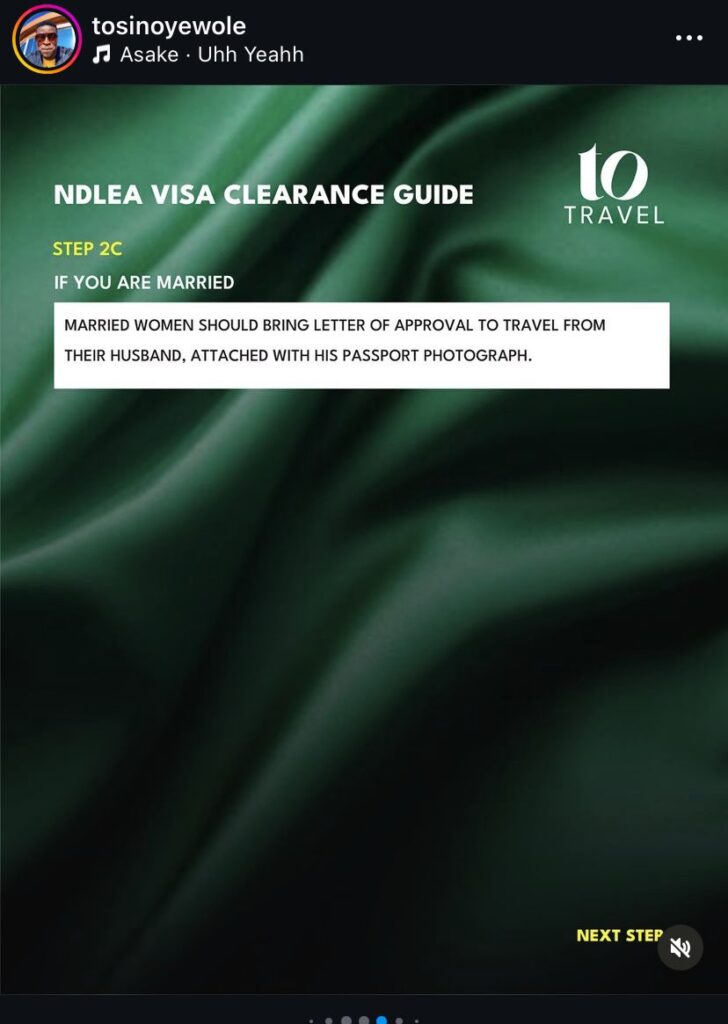
The National Drug Law Enforcement Agency (NDLEA) has taken a significant step by abolishing a controversial visa clearance policy that required married women to provide a letter of approval from their husbands before they could travel. The decision comes after widespread criticism of the rule, which many described as discriminatory, outdated, and reinforcing gender inequality.
For years, the NDLEA had enforced this rule as part of its visa clearance requirements for certain countries, sparking frustration, particularly among women’s rights groups. The requirement was seen as unjust, as it placed married women under extra scrutiny compared to single women and men. The idea that a woman needed her husband’s permission to travel was viewed by many as a violation of her rights and independence.
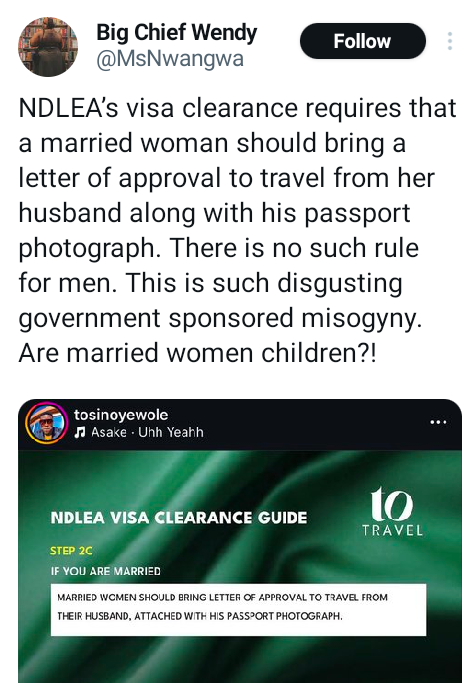
The rule recently gained even more attention when it was highlighted on social media, leading to public outrage. Critics labeled the requirement as an example of government-sponsored misogyny and demanded its immediate removal. Activists pointed out that the policy was not only outdated but also failed to reflect modern values that promote equality and fairness for all, regardless of gender.
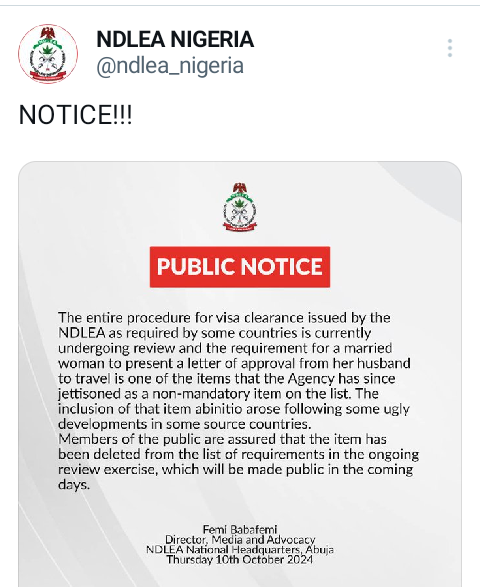
On Thursday, October 10, 2024, the NDLEA’s spokesperson, Femi Babafemi, announced that the agency had officially removed the requirement for married women to present a letter of approval from their husbands as part of their visa clearance process. Babafemi confirmed that this change is part of a broader review of the entire visa clearance procedure.
“The entire procedure for visa clearance issued by the NDLEA, as required by some countries, is currently under review. The requirement for a married woman to present a letter of approval from her husband to travel is one of the items the Agency has since discarded as a non-mandatory requirement,” Babafemi said.
He explained that the rule was initially introduced due to certain problems in some source countries, but it is no longer necessary. “Members of the public are assured that this item has been removed from the list of requirements in the ongoing review, which will be made public in the coming days,” Babafemi added.
The NDLEA’s decision to remove this policy has been applauded by many as a move toward promoting gender equality in Nigeria. Women’s rights advocates have long argued that such rules reinforce traditional gender roles that limit the autonomy of women, particularly married women. They contend that no married woman should be forced to seek her husband’s permission to travel, as this undermines her freedom to make decisions about her life.
By discarding this controversial rule, the NDLEA is acknowledging these concerns and taking steps to align its policies with global standards of fairness and equality. The agency’s willingness to review and update its procedures also reflects a broader recognition that outdated policies should be replaced with those that respect individual rights.
While this move by the NDLEA has been welcomed, activists and the public are awaiting the full release of the updated visa clearance procedures to ensure that other potentially discriminatory policies are also addressed. There is hope that this review will lead to more progressive and inclusive policies that safeguard the rights of all individuals, regardless of their marital status or gender.
As Nigeria continues to evolve in its approach to gender issues, the NDLEA’s decision marks a positive shift toward creating an environment where all citizens can enjoy equal rights, without facing unnecessary barriers based on outdated traditions.
In the coming days, as the NDLEA completes its review and publishes its new guidelines, many will be watching closely to see how these changes impact the overall travel and visa process for Nigerian women.
This update by the NDLEA not only reflects the need to modernize public policies but also highlights the importance of ensuring that women are treated equally in all aspects of life, including their right to travel freely. It is a step toward correcting years of inequality and fostering a more inclusive and fair society for everyone.