ABUJA, Nigeria — The Federal Government has defended its proposed $21.7 billion supplementary external borrowing plan, describing it as a strategic investment in critical infrastructure rather than an attempt to accumulate debt.
The Minister of Finance and Coordinating Minister of the Economy, Taiwo Oyedele, made the clarification while briefing State House correspondents after Wednesday’s Federal Executive Council (FEC) meeting presided over by President Bola Tinubu in Abuja.
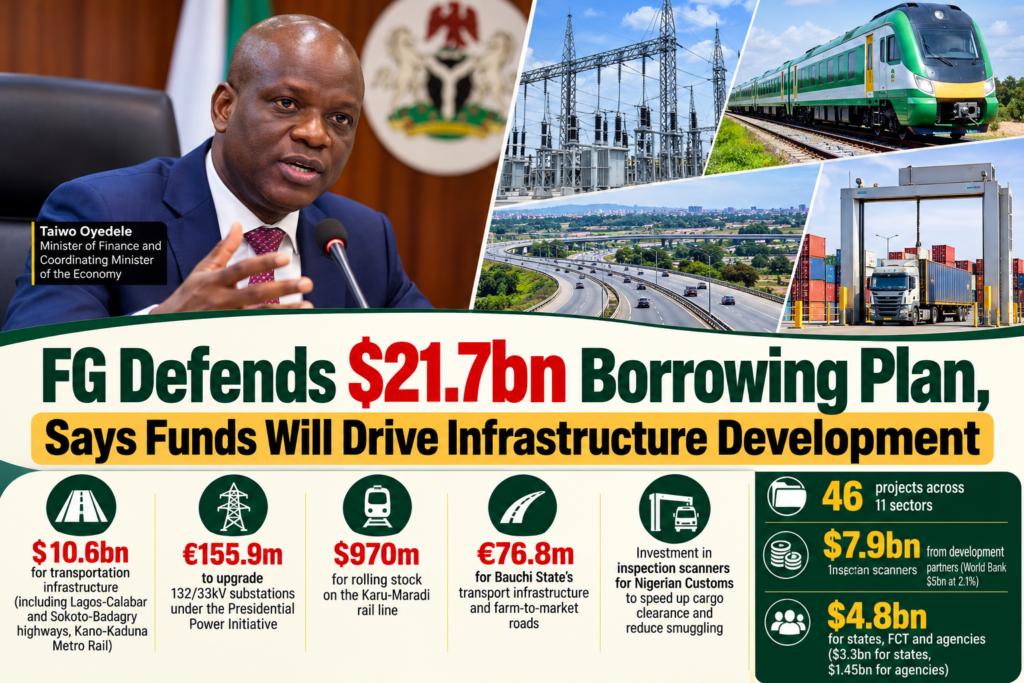
Oyedele said the borrowing plan was designed to finance 46 projects across 11 sectors, with an average project lifespan of five years. He stressed that the proposal represented a financing plan and did not mean the government would necessarily borrow the entire amount.
According to him, approximately $10.6 billion would be allocated to transportation infrastructure, including sections of the Lagos-Calabar and Sokoto-Badagry highways and the Kano-Kaduna Metro Rail project.
The minister disclosed that 29 of the 46 projects would be financed through concessional or blended financing arrangements, while about $7.9 billion would come from multilateral and bilateral development partners.
He identified the World Bank as the largest contributor among the development partners, with a proposed $5 billion facility at an average interest rate of 2.1 per cent.
Oyedele also explained that $4.8 billion of the proposed financing would support subnational governments and government agencies, including $3.3 billion earmarked for states and $1.45 billion channelled through agencies and development finance institutions.
He argued that the figures should not be interpreted as borrowing for the Federal Government alone, noting that the government serves as the constitutional interface for external borrowing.
FEC Approves Power, Rail and Transport Financing
The minister disclosed that the council approved 10 memoranda covering infrastructure development and other economic priorities.
Among them was a €155.9 million credit facility from Deutsche Bank and other lenders to upgrade 132/33kV substations under the Presidential Power Initiative.
He said the project would improve electricity reliability for households and businesses while helping to reduce energy costs.
The council also approved a $970 million syndicated term loan from Standard Chartered and the Africa Finance Corporation for rolling stock on the Karu-Maradi rail line, aimed at improving freight transportation, regional trade and logistics along the Northern Economic Corridor.
Another €76.8 million credit facility from the ECOWAS Bank for Investment and Development was approved for Bauchi State’s transport infrastructure development programme.
The funding is expected to support rural and urban roads, including farm-to-market routes intended to improve agricultural distribution and food security.
Oyedele added that the council approved investment in non-intrusive inspection scanners, technical support and maintenance for the Nigerian Customs Service to accelerate cargo clearance, combat smuggling and improve the detection of prohibited goods and small arms.
Government Cites Economic Reforms
Defending the administration’s economic policies, Oyedele said Nigeria faced significant fiscal and monetary challenges when the Tinubu government assumed office in May 2023.
He claimed that more than ₦30 trillion had been printed and spent by the previous administration, arguing that the resulting inflationary pressures continued to affect the economy.
The minister also cited the country’s low net foreign reserves, foreign exchange market distortions, high debt-service burden and salary arrears in several states as challenges inherited by the current administration.
According to him, the government’s reforms have helped improve key economic indicators, including economic growth, foreign reserves and public revenue.
He said Nigeria’s GDP growth accelerated from 2.74 per cent in May 2023 to 4.43 per cent in the second quarter of 2026, while inflation declined to 14.63 per cent in September 2026 from 20.98 per cent a year earlier.
The minister further disclosed that gross foreign reserves had risen above $55 billion, while net reserves exceeded $45 billion.
He also said the debt-service-to-revenue ratio had fallen from 97 per cent in 2023 to below 60 per cent, attributing the improvement to fiscal reforms and stronger government revenues.
Oyedele maintained that borrowing could support economic growth if the funds were invested in projects capable of generating returns and creating long-term value.
He cited private-sector investments, including the Dangote Refinery, as examples of how financing could accelerate the delivery of major infrastructure and industrial projects.
FG Targets Stable Food Prices
On food security, Oyedele said the Federal Executive Council had adopted measures to stabilise or reduce the prices of essential food items, including rice, yam, beans and maize, before the end of the year.
He said the Federal Government would work with state governments under the National Economic Council’s 90-day action plan to address gaps between domestic food production and consumption.
The government also plans to expand irrigation farming, improve agricultural yields through science and technology, and reduce post-harvest losses.
Oyedele said any targeted rice imports would be limited to unprocessed brown rice to protect local milling businesses and preserve domestic processing capacity.
He added that the government’s longer-term objective was to make food more affordable, strengthen domestic production and expand exports of processed agricultural products.
FG Defends Borrowing Amid Criticism
The minister’s defence comes amid criticism of President Tinubu’s request to the National Assembly for approval of the $21.7 billion supplementary external borrowing plan.
Former Vice President Atiku Abubakar, the presidential candidate of the African Democratic Congress, and other political groups have questioned the proposal.
Atiku on Tuesday urged the National Assembly to suspend consideration of the request until the Federal Government publicly disclosed the projects the proposed loans would finance.
However, the Federal Government maintains that the plan is intended to fund strategic infrastructure, support economic expansion and improve living standards through investments in transportation, energy, agriculture and other critical sectors.