
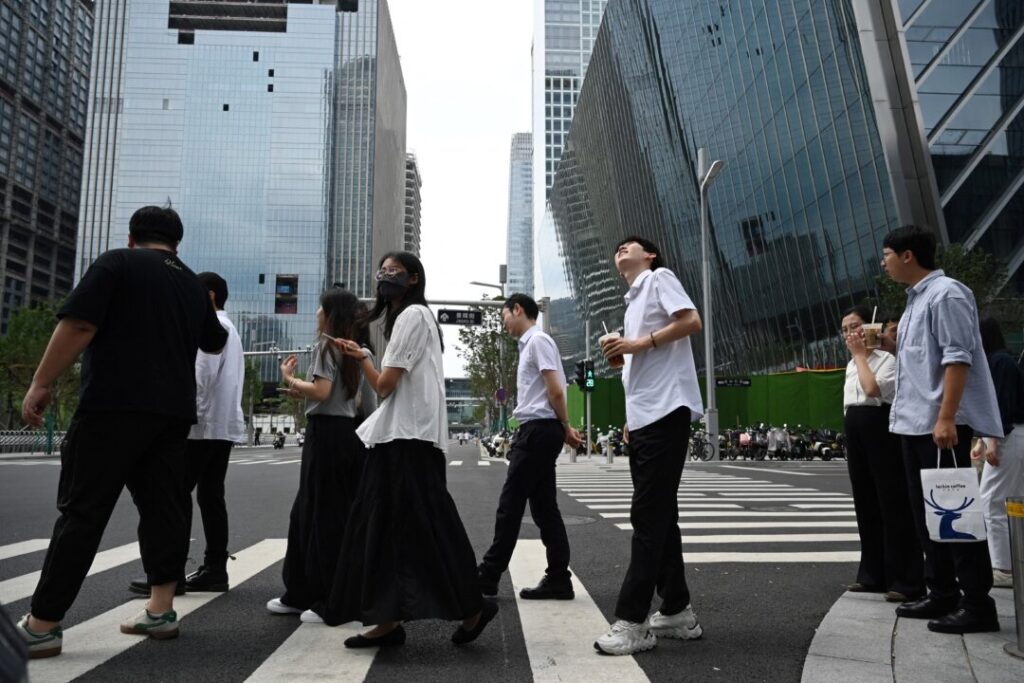
For years, Beijing symbolized opportunity for ambitious young Chinese. The capital’s elite universities, powerful state-owned enterprises, and fast-growing technology firms attracted waves of graduates from across the country seeking careers, wealth, and upward mobility.
But as China’s economic slowdown persists, the once-alluring “Beijing dream” appears to be losing its appeal. Following this year’s Lunar New Year holiday, many young workers are questioning whether returning to the capital remains worth the financial and personal strain.
Youth Population Declines Amid Employment Pressures
Official figures suggest the shift may already be underway. Data from Beijing’s municipal statistics bureau show that by the end of 2024 the city’s population of residents aged 20 to 34 had dropped to about 4.54 million—down 345,000 from the previous year and more than 1.2 million lower than in 2020.
Updated figures for 2025 have not yet been released.
The decline comes as youth employment challenges deepen across China. Statistics released Jan. 22 indicated that the unemployment rate among non-student youth aged 16 to 24 stood at 16.5 percent in December 2025, marking a fourth consecutive monthly decline, according to Chinese media outlet NetEase.
Some analysts, however, say the official data may understate the severity of the situation. U.S.-based China affairs commentator Wang He said the figures only track urban youth unemployment and exclude many rural young people, while various forms of hidden unemployment also remain uncounted.
Young Workers Reconsider Life in the Capital
As job prospects become less certain, some young Chinese are rethinking the long-held belief that success requires moving to one of the country’s largest cities.
The shift is increasingly visible in the post-holiday return migration to Beijing, which historically brought massive flows of workers back to the capital.
Zhou Lin, a college-educated worker born in the 1990s, chose not to return to his hometown for the Lunar New Year this year, spending the holiday alone in his rented apartment in Beijing.
“It feels like there are fewer people around,” Zhou said. “The whole society feels lost right now. People can’t see where the future is going.”
Four years ago, Zhou joined the ranks of so-called “Beijing drifters”—young migrants who move to the capital in search of opportunity. In previous years he would return home for the holiday with savings from the year’s work. This year was different.
Zhou said he skipped the trip because he struggled to find stable long-term employment throughout 2025 and saw his income decline.
“There are really a lot of people who can’t find jobs,” he said. “Even if you get a job, you might work yourself to exhaustion and still earn only a few thousand yuan a month.”
Some Choose to Leave the Capital
Among Zhou’s friends and colleagues, many returned to their hometowns for the holiday—but some have already decided not to return to Beijing at all.
“A lot of people just aren’t coming back,” he said, particularly those born in the 1990s and 2000s. “Many would rather stay at home and ‘lie flat.’”
The phrase “lying flat,” widely used among young Chinese in recent years, refers to rejecting the intense competition of urban professional life and embracing a simpler, lower-cost lifestyle.
For some, the financial logic is straightforward. Living with parents in smaller cities or rural areas costs far less than surviving in Beijing’s expensive housing and labor markets.
Others who remain in the capital say financial pressure remains severe even with steady employment.
Lin Ming, another millennial migrant worker in Beijing, earns about 10,000 yuan (roughly $1,400) a month—an income considered modest in the capital.
Seeking additional income, he said he sometimes works part-time delivering food after work.
“I even tried delivering food after work, sometimes until after 10 p.m.,” Lin said. “Running around in the wind and rain all month might bring in only another thousand yuan. I don’t know how long I can hold on in Beijing.”
For lower-income workers, the financial strain is even greater.
Lu Xin, who earns just over 6,000 yuan a month, said rent alone consumes about 2,000 yuan. Food costs roughly 1,500 yuan, while utilities and internet add another 600 yuan. Basic necessities and clothing account for around 1,000 yuan more.
After occasional social spending and sending money home to his parents during holidays, little remains.
“Before the holiday, my coworkers and friends all left Beijing early to go back home,” Lu said. “Some friends who run small businesses told me business has become harder and harder, and they don’t plan to come back after the Lunar New Year.”
Changing Attitudes Toward the Capital
Not all young workers are leaving. Some continue to pursue careers in Beijing, while others are exploring opportunities in southern Chinese cities where private-sector activity remains stronger.
Still, longtime Beijing resident Sun Wu said he has heard many young migrant workers say they no longer plan to return because life in the capital has become too difficult.
Sun also noted that the city’s political atmosphere has grown increasingly tense, making even casual conversations about economic challenges more sensitive.
For many young Chinese, the central question has quietly shifted in recent years—from how to break into Beijing to whether staying in the capital is still worth the struggle.