
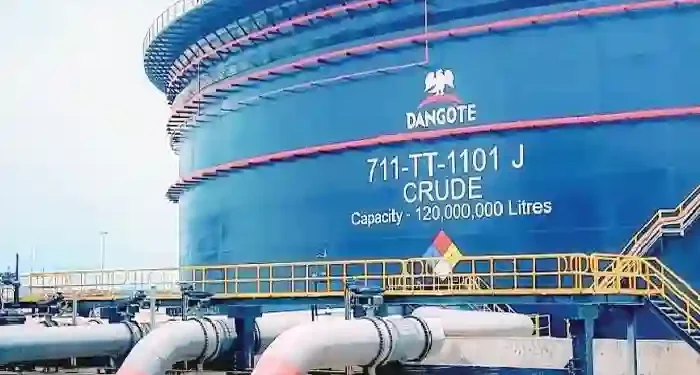
Lagos, Nigeria — Dangote Petroleum Refinery has reached full nameplate capacity of 650,000 barrels per day at its Crude Distillation Unit (CDU) and Motor Spirit (MS) production block, marking a landmark operational achievement and a first for a refinery of its scale globally.
The company announced the milestone following the successful completion of scheduled maintenance and optimization activities on the two critical processing units.
The refinery has commenced a 72-hour performance test in collaboration with technology licensor UOP to validate efficiency levels and confirm compliance with international operational standards.Chief Executive Officer David Bird described the breakthrough as a testament to the refinery’s engineering precision and operational discipline.
“Our teams have demonstrated exceptional expertise in bringing both the CDU and MS Block to peak performance,” Bird said.
“The ongoing performance test allows us to validate plant-wide operations under real-time conditions. We are confident in our ability to sustain consistent, world-class production.”
The CDU and MS Block — comprising the naphtha hydrotreater, isomerization unit and reformer — are now operating steadily at maximum capacity. According to Bird, additional processing units will undergo performance testing in Phase 2, scheduled to commence next week.
With the ramp-up, the refinery is positioned to supply up to 75 million liters of Premium Motor Spirit (PMS) daily to Nigeria’s domestic market — a significant increase from the 45–50 million liters supplied during the recent holiday season.
The milestone strengthens the refinery’s role in enhancing Nigeria’s energy security, reducing dependence on imported petroleum products and advancing the country’s ambition to become a net exporter of refined fuels.
Bird thanked customers and stakeholders for their continued support, reaffirming the refinery’s commitment to driving industrial growth and contributing to Nigeria’s broader economic transformation.