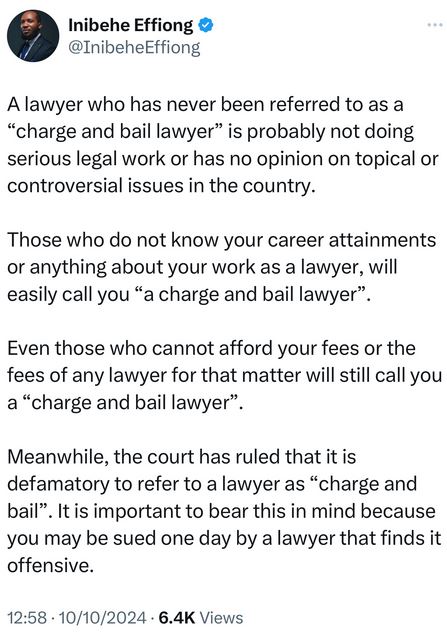

Nigerian human rights lawyer Inibehe Effiong has raised an important warning about the term “charge and bail lawyer.” He states that referring to a legal practitioner in this way can result in a defamation lawsuit if the lawyer finds it offensive and decides to take action in court.
Effiong explains that the label “charge and bail lawyer” implies that the lawyer primarily handles minor cases, often related to helping clients get bail from police custody. This can be seen as a negative portrayal of their professional reputation. If a lawyer feels insulted by this description, they may choose to defend their reputation legally.
He also points out that lawyers who have never been called “charge and bail lawyers” may not be involved in serious legal matters or may not take a stand on important issues affecting society. This raises the question of how language can impact the perception of a lawyer’s work and credibility.
In conclusion, Effiong’s message serves as a reminder that using derogatory terms can have serious consequences. Calling a lawyer a “charge and bail lawyer” might not only be disrespectful but could also lead to legal trouble if the lawyer decides to sue for defamation. It’s crucial to choose our words carefully, especially when discussing professionals in the legal field.
In a post shared on X, Inibehe wrote;
“A lawyer who has never been referred to as a “charge and bail lawyer” is probably not doing serious legal work or has no opinion on topical or controversial issues in the country.
Those who do not know your career attainments or anything about your work as a lawyer, will easily call you “a charge and bail lawyer”.
Even those who cannot afford your fees or the fees of any lawyer for that matter will still call you a “charge and bail lawyer”.
Meanwhile, the court has ruled that it is defamatory to refer to a lawyer as “charge and bail”. It is important to bear this in mind because you may be sued one day by a lawyer that finds it offensive.”