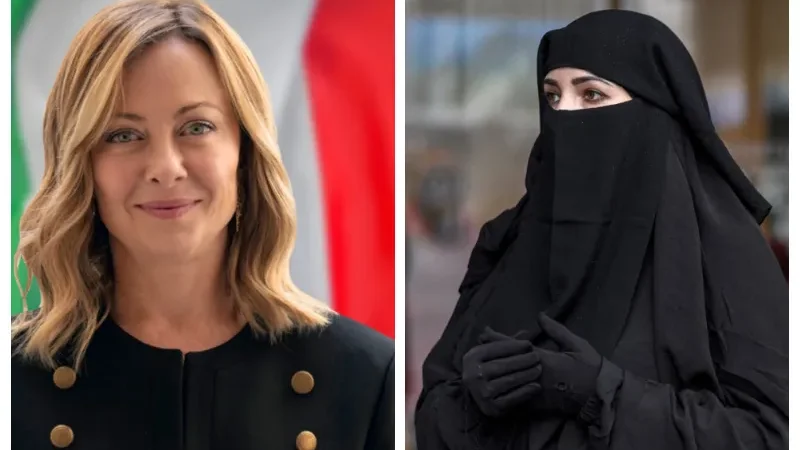
Italy is preparing new measures that would ban burqas and niqabs in schools, limit the number of foreign students in classrooms and require some parents to learn Italian, Prime Minister Giorgia Meloni announced on Sunday, September 20.
Meloni said the proposed package would soon be presented to the Italian Cabinet as part of efforts to address integration and language challenges within the country’s education system.
Under the proposal, parents of foreign pupils experiencing what authorities consider serious difficulties integrating into the Italian school system would be required to learn the Italian language. The government would also establish a legal limit on the number of foreign students allowed in each class, although Meloni did not specify the proposed cap.
Speaking at an event organised by Gioventù Nazionale, the youth wing of her Brothers of Italy party, Meloni said Italian children should not feel marginalised in classrooms where they have become a minority.
“It is unacceptable that in an Italian classroom the children who end up feeling pushed into a corner are Italian children because they have become the minority. That cannot be allowed,” she said.
Meloni also defended the proposed language requirements, arguing that people who settle in Italy should learn the language, understand the country’s culture and respect its laws.
The proposal would need to pass through the Italian legislative process before becoming law. Reports say parliamentary approval would be required within 60 days after government approval.
Italy already has rules limiting the proportion of foreign students in schools, with a 30 per cent guideline applying in certain circumstances. Foreign nationals currently account for about 12 per cent of pupils nationwide.
Several European countries, including France and Belgium, already restrict face coverings in public places, while Austria has introduced restrictions affecting schools. Rules on religious dress vary across Europe, with countries such as Spain and Poland providing constitutional protections for freedom of conscience and religion.