
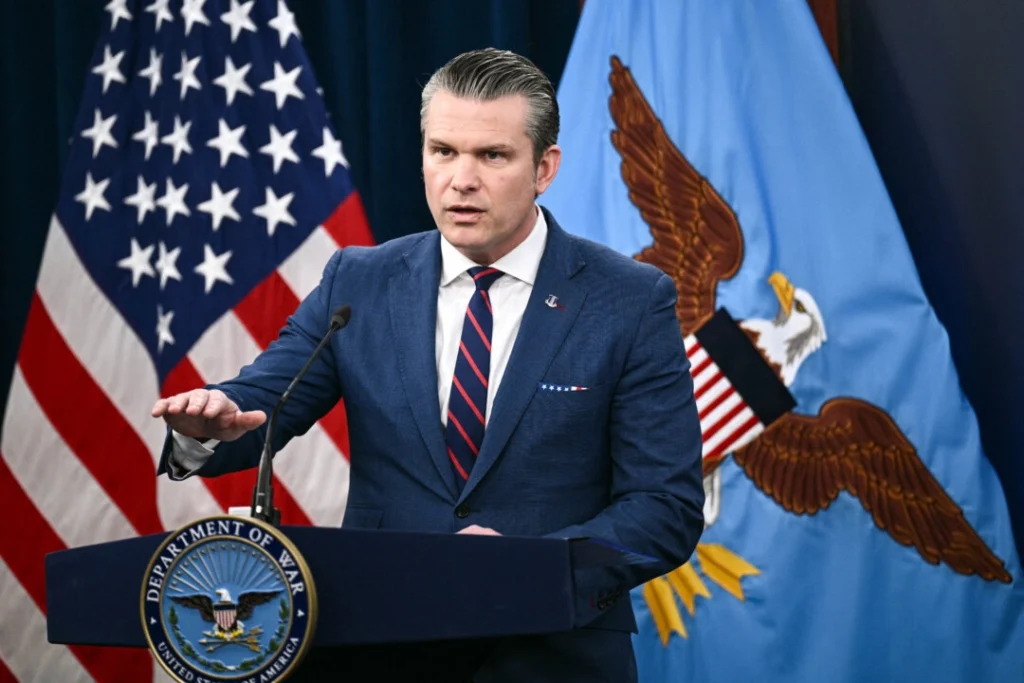
Washington, D.C. — U.S. Department of War Secretary Pete Hegseth announced Tuesday that the United States military will carry out what he described as its “most intense day” of strikes against Iran, even as President Donald Trump signaled that the more than week-long conflict could be nearing its end.
Speaking at a Pentagon news conference, Hegseth said Tuesday’s operations would involve an unprecedented scale of military activity.
“The most fighters, the most bombers, the most strikes,” Hegseth said. “Our intelligence is more refined and better than ever. At the same time, the last 24 hours have seen Iran fire the lowest number of missiles they’ve been capable of launching so far.”
Hegseth emphasized that the current military approach differs sharply from past U.S. conflicts in the Middle East, specifically referencing the 2003 invasion of Iraq.
“This is not 2003,” he said. “Our generation of soldiers will not allow that to happen again, and neither will this president, who ran clearly against the kind of open-ended, indefinite missions that defined past administrations. Those days are over.”
Meanwhile, Iran continued to launch attacks across the region Tuesday, maintaining pressure on U.S. allies and Gulf states. Missile alarms were reported in Dubai, while authorities in Bahrain said an Iranian strike killed one person and injured eight others.
Saudi Arabia reported intercepting two drones over its eastern oil-producing region, and Kuwait’s National Guard said it shot down six drones.
President Trump said Monday that the U.S. military campaign against Iran, which began Feb. 28, is “very complete,” comments that contributed to a decline in oil prices after significant increases earlier in the conflict.
However, the president warned that the United States would escalate military action dramatically if Iran attempts to disrupt oil shipments through the Strait of Hormuz, a critical maritime corridor through which millions of barrels of oil pass each day.
“If Iran does anything that stops the flow of oil within the Strait of Hormuz, they will be hit by the United States of America twenty times harder than they have been hit thus far,” Trump wrote Monday evening on Truth Social.
Energy markets have been closely monitoring the conflict. U.S. gasoline prices rose in recent days following the joint U.S.–Israel operation. Data from the American Automobile Association shows the average price of a gallon of regular gasoline increased by about six cents from Monday to Tuesday to $3.539, up from $3.109 a week earlier and $2.921 one month ago.
During Tuesday’s briefing, Chairman of the Joint Chiefs of Staff Gen. Dan Caine said the U.S. military is evaluating options to ensure the Strait of Hormuz remains open to tanker traffic. While escorting tankers has not yet been requested, Caine said military leaders are assessing “a range of options” that could be presented to the president if necessary.
The developments come as regional tensions remain high and global markets closely watch the stability of critical energy supply routes.