
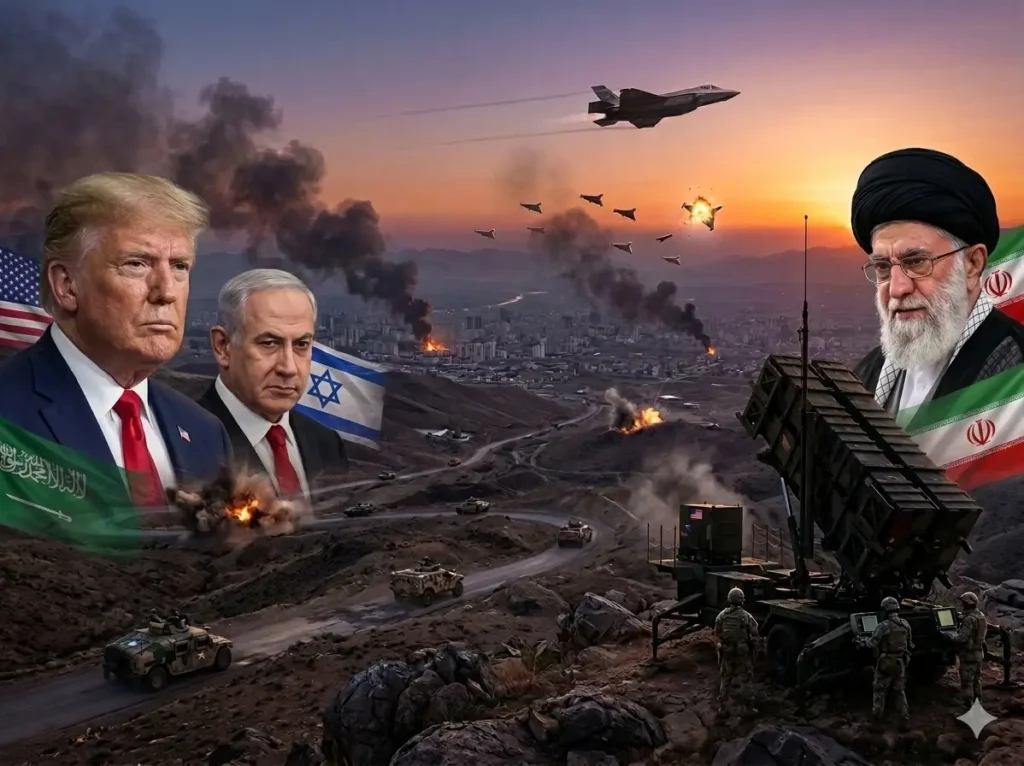
The joint U.S.–Israeli military campaign against Iran entered its second week on March 7, as President Donald Trump weighed expanding strikes to additional targets across the country.
Iranian leaders have so far rejected calls for surrender despite sustained air operations by U.S. and Israeli forces that have targeted thousands of sites across Iran. The campaign has also killed Iranian Supreme Leader Ayatollah Ali Khamenei along with numerous senior military and intelligence officials.
While Washington says its forces are prepared for a prolonged operation, the conflict has already reverberated across the Middle East, disrupting regional stability and threatening oil flows through the Persian Gulf.
The operation—officially dubbed Operation Epic Fury—has so far unfolded primarily in the air, though U.S. officials have not ruled out additional military options.
Air Campaign Dominates First Week
The opening phase of the conflict has been defined by an extensive aerial battle. U.S. and Israeli forces have conducted missile strikes and air operations aimed at dismantling Iran’s air defenses and military infrastructure, while Iran has retaliated with missile and drone attacks across the region.
During a March 4 Pentagon briefing, Defense Secretary Pete Hegseth and Chairman of the Joint Chiefs of Staff Gen. Dan Caine outlined a strategy to gradually degrade Iran’s air defense network and establish increasing control of Iranian airspace.
By March 5, U.S. Central Command commander Adm. Brad Cooper said Iranian missile attacks had fallen by 90 percent since the conflict began, while drone strikes had declined by 83 percent.
No U.S. ground troops have been deployed, but the White House has not ruled out that possibility. Press Secretary Karoline Leavitt said military options remain available to the president if necessary.
Tehran Rejects Surrender
Iran’s leadership has rejected Washington’s demand for capitulation.
In a March 7 video address, Iranian President Masoud Pezeshkian dismissed calls for surrender, describing them as unrealistic and declaring that Iran’s adversaries “should take that dream to their grave.”
A day earlier, Trump reiterated his stance on social media, writing that there would be “no deal with Iran except unconditional surrender.”
The president has also warned that the United States could expand its list of targets if Iran continues its attacks. In a post on March 7, Trump said additional regions and groups could face “complete destruction” if Tehran does not change course.
Trump has also indicated he intends to play a role in determining Iran’s future leadership, referencing a model similar to his administration’s recent intervention in Venezuela.
Regional Tensions Escalate
The fighting has increasingly drawn in other parts of the Middle East.
Israel has diverted forces to its northern border with Lebanon, launching strikes against Hezbollah, the Iran-backed militant group. Israeli forces report striking dozens of targets across Lebanon, with several Israeli troops injured in the clashes.
The violence has displaced more than 100,000 Lebanese residents after evacuation orders were issued in several areas.
Meanwhile, Iranian missile and drone strikes have targeted multiple Gulf states, including Bahrain, Kuwait, Oman, Qatar, Saudi Arabia, and the United Arab Emirates.
The U.S. State Department said about 24,000 Americans have been evacuated or repatriated from across the Middle East since hostilities began.
In his March 7 remarks, Pezeshkian apologized to Gulf nations affected by Iranian strikes and said Iranian forces had been instructed not to attack neighboring countries unless they are used as staging grounds for attacks against Iran.
Concerns Over Weapons Stockpiles
The high tempo of missile strikes and air defense operations has raised concerns in Washington about U.S. weapons stockpiles.
Members of Congress have warned that the conflict could strain supplies of long-range strike munitions and missile interceptors.
“These munitions take a long time to replenish and risk being unavailable for unforeseen contingencies elsewhere,” Sen. Mazie Hirono said during a March 4 Senate Armed Services Committee hearing.
Amid those concerns, Trump met March 6 with executives from major U.S. defense contractors—including BAE Systems, Boeing, Honeywell Aerospace, L3Harris Missile Solutions, Lockheed Martin, Northrop Grumman, and Raytheon—to discuss expanding production.
Trump later said the companies had agreed to significantly increase manufacturing capacity, including plans to quadruple production of certain advanced weapons systems.
Oil Markets on Edge
The conflict has also rattled global energy markets as missile and drone attacks raise concerns about shipping through the Persian Gulf.
Roughly a quarter of the world’s seaborne oil passes through the narrow Strait of Hormuz, making the waterway a critical artery for global energy supplies.
The United Kingdom Maritime Trade Operations monitoring group has reported multiple incidents involving commercial vessels in the Gulf and near the Strait of Hormuz since the fighting began.
Oil prices surged and stock markets declined when U.S. markets opened March 2, prompting Secretary of State Marco Rubio to reassure investors that the administration was preparing measures to stabilize fuel prices.
Trump has suggested deploying U.S. warships to escort tankers through the Strait of Hormuz. The administration has also announced a $20 billion federal reinsurance program aimed at stabilizing maritime shipping and has granted India a 30-day waiver to continue purchasing otherwise-sanctioned Russian oil.