
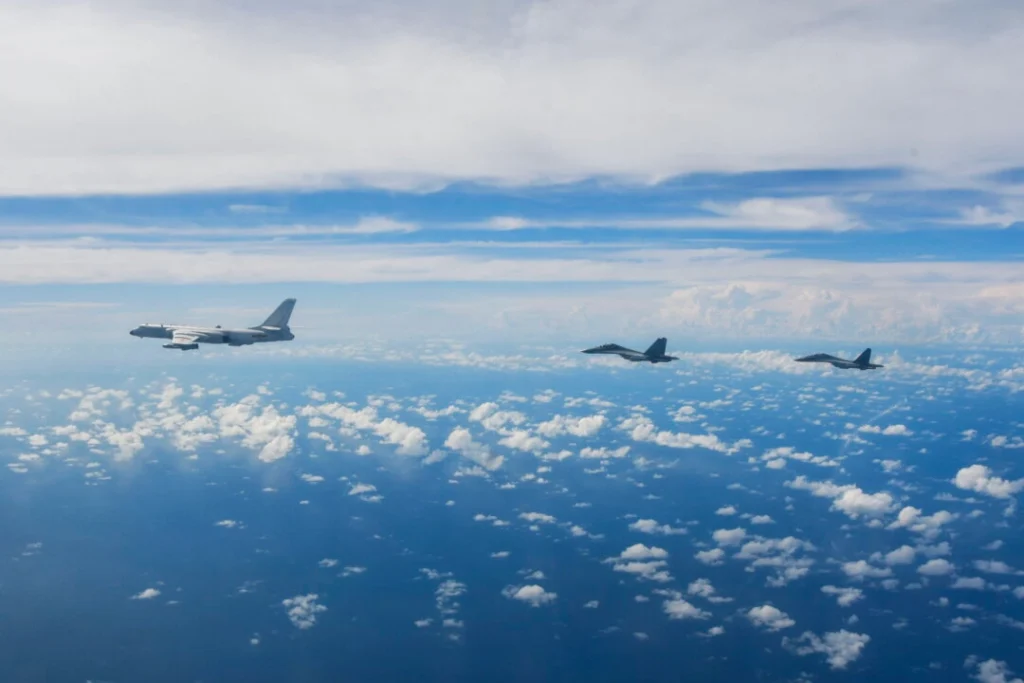
China has suspended military aircraft incursions near Taiwan for more than a week, a rare pause that comes as the United States wages war against Iran and Beijing prepares for a high-stakes meeting between President Donald Trump and Chinese Communist Party leader Xi Jinping.
Taiwan’s Ministry of National Defense reported that Chinese military aircraft did not enter Taiwan’s Air Defense Identification Zone (ADIZ) for eight consecutive days, from Feb. 27 through March 6—an unusual break in what has been almost daily flights intended to pressure the self-governed island.
The pause coincides with several major developments: China’s ruling Chinese Communist Party is holding its annual “Two Sessions” political meetings, and Xi is expected to host Trump in Beijing on April 1.
Analysts say the halt in military activity likely reflects a strategic recalibration by Beijing amid shifting geopolitical and economic pressures.
The timing also overlaps with the rapidly escalating conflict in the Middle East. On Feb. 28, the United States and Israel launched military strikes against Iran that killed the country’s leader, Ayatollah Ali Khamenei.
Israeli officials say the joint operation has since destroyed more than 60 percent of Iran’s missile launchers and rendered roughly 80 percent of its air defense systems ineffective.
President Trump said on March 7 that U.S. forces had also destroyed 42 Iranian naval vessels within three days, severely crippling Iran’s naval capabilities.
Taiwanese lawmaker Lin Chun-hsien said the rapidly evolving situation in Iran may have forced Beijing to reassess its broader confrontation strategy with Washington.
“The changing regional situation is pushing the Chinese Communist Party into a period of strategic contraction,” Lin wrote on Facebook on March 5, adding that Beijing may also be reconsidering how it applies pressure in the Taiwan Strait.
Chen Wen-Chia, vice president of Kainan University and a defense strategy expert, said the pause appears to be a tactical adjustment shaped by military, diplomatic, and international considerations.
“It is not uncommon for Beijing to temporarily reduce military pressure on Taiwan during diplomatically sensitive periods,” Chen said. “Before major talks or summits, the CCP often de-escalates tensions to preserve negotiating space and maintain a more stable international image.”
Energy considerations may also be a factor. China remains the largest buyer of Iranian oil, purchasing more than 80 percent of Iran’s exported shipments in 2025.
According to a January study by the Center on Global Energy Policy, China imported a record 11.6 million barrels of crude per day last year, with roughly 1.38 million barrels per day—about 12 percent—coming from Iran.
Sanctioned Iranian crude has typically traded at steep discounts, sometimes $8 to $10 per barrel below benchmark Brent prices. Disruptions to Iranian supply during the conflict could therefore remove a significant portion of the discounted oil China relies on.
Analysts also say the U.S. military campaign may be influencing Beijing’s calculations. The strikes have weakened one of China’s key partners in the Middle East, while American operations reportedly neutralized Chinese-supplied air defense systems deployed in Iran and Venezuela—developments that could raise concerns within China’s leadership.
Shen Ming-shih, a research fellow at Taiwan’s Institute for National Defense and Security Research, said Beijing is unlikely to risk a military invasion of Taiwan while the United States demonstrates its willingness to use force.
“Trump has repeatedly warned Xi Jinping not to use force against Taiwan,” Shen said. “Within Trump’s second term, which ends in 2028, the CCP is unlikely to launch a rash military invasion.”
Recent messaging from China’s Taiwan Affairs Office has also emphasized peaceful reunification and political influence efforts rather than military escalation, echoing language used by Chinese Premier Li Qiang during the Two Sessions.
Still, analysts caution that the current pause does not necessarily signal a long-term reduction in military pressure.
Chen noted that China’s air and naval operations around Taiwan have become routine in recent years, and extended deployments require periodic maintenance, resupply, and training rotations.
“It’s possible the PLA is preparing for the next phase of operations,” he said. “Larger-scale joint exercises could follow.”
Indeed, Taiwan’s defense ministry reported on March 7 that two Chinese People’s Liberation Army auxiliary aircraft entered Taiwan’s southwestern airspace, while six PLA Navy vessels were detected operating near the island.