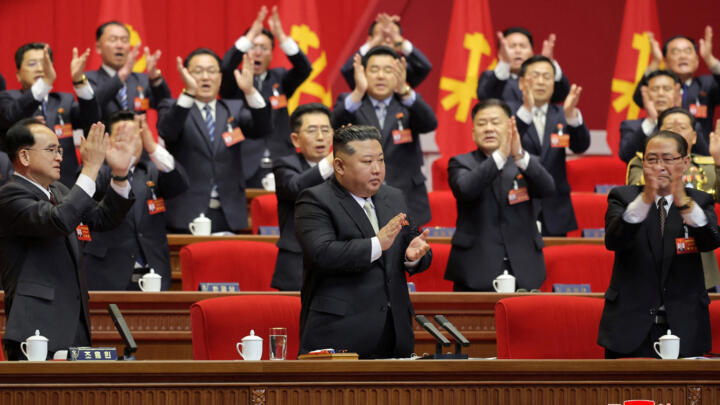
Pyongyang, Feb. 24 — North Korean leader Kim Jong Un has been re-elected as general secretary of the ruling Workers’ Party of Korea, according to a report released Monday by the state-run Korean Central News Agency (KCNA).
KCNA said the decision was formally adopted on Feb. 22 during the Party’s Ninth Congress, reaffirming Kim’s leadership amid what the report described as significant advances in national defense and economic policy.
The state media outlet credited Kim with strengthening the country’s war deterrence capabilities, emphasizing that North Korea’s “nuclear forces as its pivot” have been “radically improved” under his leadership.
The report cited progress in nuclear weapons and missile development, alongside economic initiatives, as key factors behind the reappointment.
KCNA also announced that party rules were revised during the congress but did not provide details on the specific changes.
In addition, the congress selected new members of the Party’s Central Committee. However, the published list omitted several prominent figures, including Choe Ryong Hae, chairman of the Standing Committee of the Supreme People’s Assembly, prompting speculation among South Korean analysts that a generational shift in party leadership may be underway.
Kim, who has led North Korea since 2011 following the death of his father, Kim Jong Il, formally assumed the title of general secretary in 2021, reviving a position previously held by his late father.
The KCNA report suggested that Pyongyang may use the conclusion of the congress to showcase advancements in intercontinental ballistic missiles (ICBMs), submarine-launched ballistic missiles (SLBMs), and hypersonic glide vehicles, underscoring efforts to enhance the survivability and precision of its nuclear arsenal.
In a separate analysis, the American Enterprise Institute (AEI) assessed that North Korea could unveil new strategic weapons following the congress and highlight progress under its 2021–2025 military modernization plan.
AEI further suggested that Kim may outline objectives for the 2026–2030 period, potentially focusing on second-strike capabilities, accelerated launch readiness, and diversification of delivery systems.