
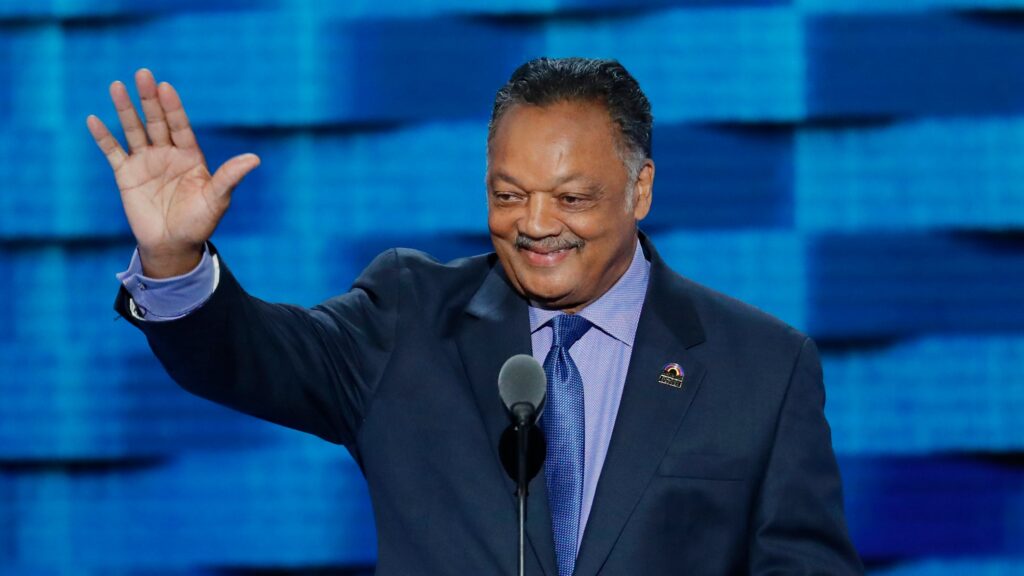
Jesse Jackson, the pioneering civil rights leader, Baptist minister and two-time Democratic presidential candidate who reshaped American politics and championed racial and economic justice for more than six decades, has died at the age of 84.
The Jackson family confirmed his passing in a statement released Tuesday morning, February 17.
“His unwavering commitment to justice, equality, and human rights helped shape a global movement for freedom and dignity. A tireless change agent, he elevated the voices of the voiceless – from his presidential campaigns in the 1980s to mobilizing millions to register to vote – leaving an indelible mark on history,” the statement read.
Jackson had been hospitalized in recent months and was under medical observation for progressive supranuclear palsy (PSP), according to his organization, the Rainbow PUSH Coalition.
A protégé of Martin Luther King Jr., Jackson emerged as a prominent voice in the modern Civil Rights Movement, confronting Jim Crow segregation laws as a college student and rising to national prominence for his impassioned oratory and bold advocacy for racial equality.
Through the Southern Christian Leadership Conference (SCLC) and later the Rainbow PUSH Coalition, Jackson pressed for expanded economic opportunity, voter participation and social justice reforms.
Born Jesse Louis Burns on October 8, 1941, in Greenville, South Carolina, Jackson was raised during the height of the Jim Crow era. He later took the surname of his stepfather, Charles Jackson, and excelled academically and athletically, graduating with honors from Sterling High School, where he served as class president.
After initially attending the University of Illinois on a football scholarship, Jackson transferred to North Carolina A&T State University, where he became deeply involved in civil rights activism. In 1960, he helped organize a sit-in at the segregated Greenville County Public Library.
The protest led to his arrest alongside seven other Black students, who became known as the “Greenville Eight.” The action ultimately contributed to the desegregation of the library system.
Jackson later studied theology at the Chicago Theological Seminary but deferred his studies to work full-time alongside King. He was ordained a minister in 1968 and, decades later, received a Master of Divinity degree from the seminary in 2000.
Within the SCLC, Jackson led Operation Breadbasket, an initiative aimed at improving economic conditions in Black communities through corporate accountability and job creation efforts.
In 1971, he founded what would become the Rainbow PUSH Coalition, expanding his advocacy to issues of economic empowerment, education and voting rights.
Jackson carried his civil rights activism into electoral politics with two historic bids for the Democratic presidential nomination.
In 1984, widely viewed as a long-shot candidate, he won 18 percent of the primary vote and carried two states. His 1988 campaign was even more formidable, earning 29 percent of the vote and victories in 13 states, making him the first Black candidate to win the nationwide Democratic youth vote.
His campaigns inspired a new generation of minority leaders and helped move the Democratic Party’s platform toward greater social and economic progressivism heading into the 21st century.
Jackson remained an influential political figure throughout the 1990s and 2000s. From 1991 to 1997, he served as Washington, D.C.’s “shadow senator,” an unofficial, unpaid role advocating for D.C. statehood.
Over a career that spanned more than 60 years, Jackson became one of the most recognizable and enduring figures in American public life — a relentless advocate for civil rights, economic justice and political inclusion whose legacy reshaped the nation’s civic landscape.