
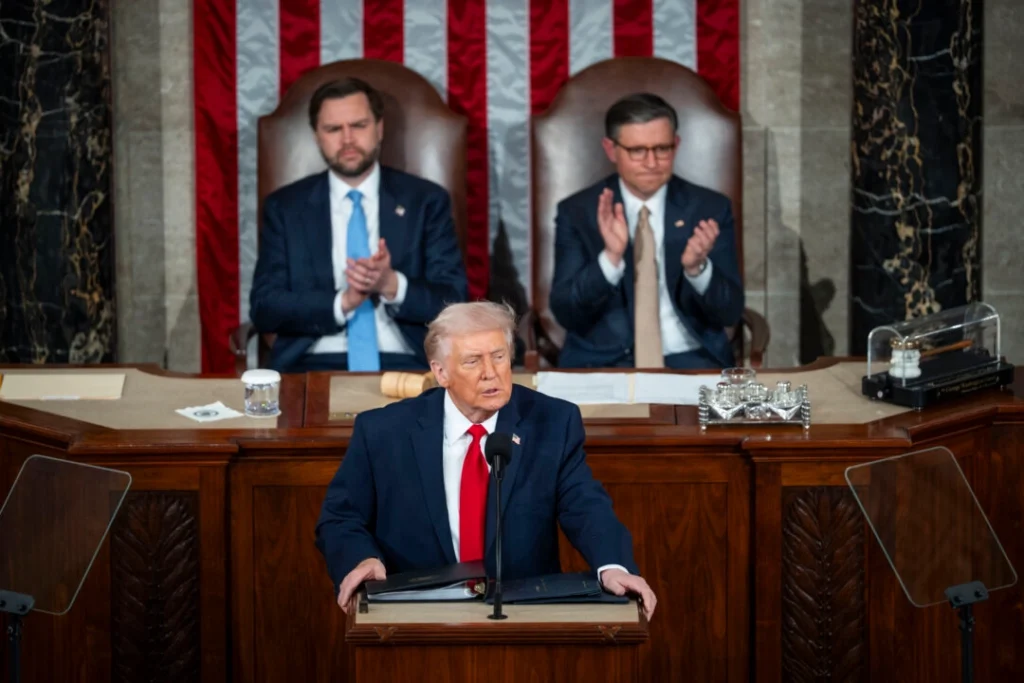
President Donald Trump on Tuesday called on Congress to enshrine his prescription drug pricing initiative into federal law, elevating health care reform as a centerpiece of his State of the Union address and setting up a potential bipartisan debate on Capitol Hill.
During his address to a joint session of Congress, Trump urged lawmakers to codify his “Most-Favored-Nation” prescription drug pricing policy, which aims to align U.S. drug costs with the lowest prices offered in other developed nations. Some Republican lawmakers signaled openness to advancing the measure.
Rep. Byron Donalds (R-Fla.) applauded the proposal’s potential to reduce costs for patients. “That really does matter to the American people,” Donalds said after the speech. “Working with the president on codifying those things into law is important.”
To underscore the policy’s impact, Trump introduced Catherine Rayner as a guest during the address. Rayner and her husband had struggled with infertility and faced a $4,000 price tag for in vitro fertilization (IVF) medication. Through TrumpRx.gov, a clearinghouse website established under the initiative, she said she was able to purchase the same medication for $500.
According to the administration, 15 pharmaceutical companies have agreed to participate in the voluntary framework. The companies have committed to offering their lowest available prices to Medicaid patients, launching new drugs in the United States at their lowest global price, and selling certain medications directly to Americans at reduced rates.
However, the specific terms of the agreements have not been publicly released, leaving the overall scope and scale of price reductions unclear.
Merith Basey, CEO of Patients for Affordable Drugs, said in a Feb. 24 statement that the current arrangements do not automatically lower prices across the broader pharmaceutical market and do not apply to many high-cost or widely used medications. Still, she said congressional action could strengthen the impact.
“If Congress codifies a strong, enforceable [Most-Favored Nation]-style policy into law, it could be a meaningful step toward bringing U.S. prices in line with those paid by other high-income countries,” Basey said.
Trump’s broader “Great Health Care Plan,” first announced Jan. 15, also includes proposals to establish federally funded Health Savings Accounts (HSAs) for Affordable Care Act enrollees as an alternative to insurer subsidies. Eligible individuals could use the funds to pay insurance premiums or out-of-pocket medical expenses.
The plan further calls for enhanced price transparency, requiring health care providers and insurers that accept Medicare or Medicaid to prominently post their prices.
Sen. John Hoeven (R-N.D.) expressed optimism about the HSA proposal’s legislative prospects. “I think we could get bipartisan support and pass it,” Hoeven said, adding that the approach would give individuals more control over their health care spending.
Policy analysts cautioned that key elements of the initiative remain undefined. Jeremy Nighohossian, a senior fellow and economist at the Competitive Enterprise Institute, said it is unclear whether codification would formalize the TrumpRx.gov platform, extend pricing agreements to Medicare, or take another form entirely.
Rep. Glenn Grothman (R-Wis.) noted that lawmakers have yet to see full legislative language and acknowledged potential political hurdles, including pharmaceutical industry influence. He suggested that advancing drug pricing reform could require the budget reconciliation process, which allows certain fiscal measures to pass with a simple majority in the Senate.
Supporters of the transparency provisions also voiced approval. Cynthia Fisher, founder and chairman of Patient Rights Advocate, said in a Feb. 24 statement that the administration’s transparency push would foster competition and help protect patients from excessive charges.
Democrats, however, dismissed the proposals as insufficient. In a Feb. 24 statement, the Democratic National Committee said Trump’s plan “won’t bring down health care costs or lower drug prices,” arguing that Democrats have repeatedly advanced alternative proposals aimed at reducing costs.