
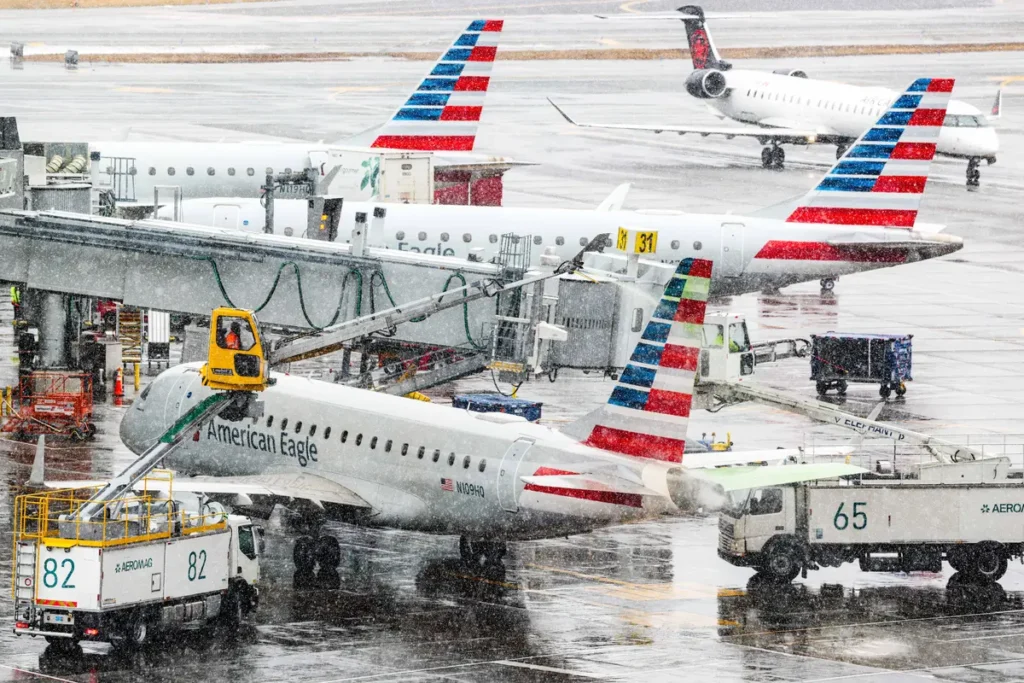
More than 10,000 flights were canceled across the United States between Feb. 22 and Feb. 24 as a powerful Nor’easter swept through the East Coast, unleashing heavy snow, damaging winds, and coastal flooding that severely disrupted air travel and daily life.
According to data from FlightAware, airlines canceled 3,440 flights on Feb. 22, followed by 5,535 cancellations on Feb. 23. As of Feb. 24, an additional 1,619 flights had been scrapped.
Major hubs in the Northeast were among the hardest hit. On Feb. 23, 88 percent of departing flights and 87 percent of arriving flights at John F. Kennedy International Airport were canceled. At Boston Logan International Airport, 92 percent of outbound flights and 87 percent of inbound flights were grounded the same day.
The National Weather Service’s Weather Prediction Center warned on Feb. 23 that intense snowfall rates of 2 to 3 inches per hour and wind gusts of 40 to 70 mph would continue to batter the region through Monday as the storm accelerated into New England.
Coastal communities were forecast to receive storm totals of one to two feet of snow by the morning of Feb. 24.
Forecasters said the combination of heavy snow and strong winds would render travel nearly impossible from the Delmarva Peninsula to southeastern New England. In a Feb. 23 social media update, the Weather Prediction Center described the system as a “very strong Nor’easter” producing powerful winds and heavy snowfall, warning that blizzard conditions and significant impacts would persist throughout the day.
The agency also cautioned that heavy, wet snow combined with strong winds could trigger power outages across southeastern New England. Minor to moderate coastal flooding was forecast around high tide from the Chesapeake Bay to southeastern New England.
In response, officials across multiple states declared emergencies and implemented safety measures, including reduced speed limits and travel restrictions.
In New York City, Mayor Zohran Kwame Mamdani declared a state of emergency on Feb. 22, saying the move would allow authorities to expedite response efforts and ensure emergency vehicles, sanitation crews, and essential workers could operate without delay.
The city barred nonessential vehicles from the streets beginning at 9 p.m. on Feb. 22 through at least noon on Feb. 23.
New York City Public Schools closed on Feb. 23, with buildings operating as warming centers remaining open. Officials confirmed a traditional snow day, canceling after-school activities and foregoing remote instruction.
In neighboring New Jersey, Gov. Mikie Sherrill declared a state of emergency for Feb. 22 and Feb. 23, citing forecasts of heavy snowfall, strong winds, and blizzard conditions that could make travel hazardous statewide.
Boston Mayor Michelle Wu also declared a snow emergency effective 2 p.m. on Feb. 22. Boston Public Schools and municipal buildings were closed on Feb. 23 as city crews prepared for around-the-clock response and post-storm cleanup.
Officials throughout the region urged residents to remain off the roads, use public transportation if travel was necessary, and assist with recovery efforts by clearing sidewalks and complying with emergency directives as the Nor’easter moved through the Northeast.