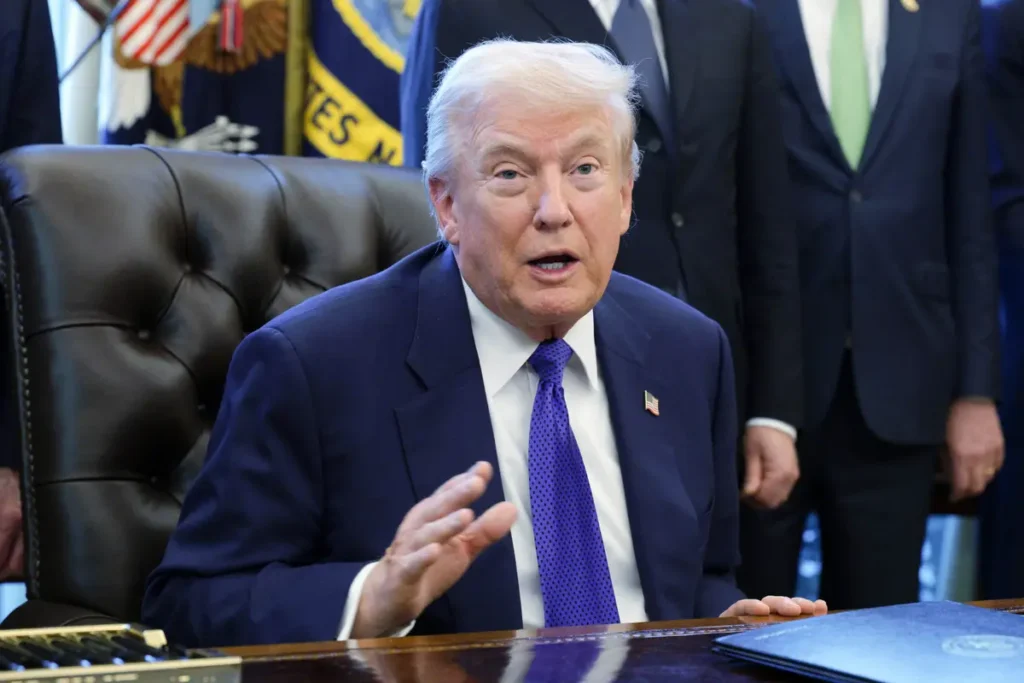
WASHINGTON, Feb. 16 — Donald Trump said Sunday that he has discussed U.S. arms sales to Taiwan with Xi Jinping and will soon decide whether to meet Beijing’s request to halt the sales.
Speaking to reporters aboard Air Force One, President Trump confirmed that the issue was raised during a recent phone call with Xi and described their conversation as constructive.
“I’m talking to him about it. We had a good conversation, and we’ll make a determination pretty soon,” Trump said, noting that despite differences, the two leaders maintain a strong working relationship. He added that he expects to travel to China in April for further talks with Xi.
The leaders spoke by phone on Feb. 4, during which Xi emphasized that Taiwan remains the most sensitive issue in U.S.–China relations and urged Washington to handle arms sales to the island “with prudence,” according to a statement released by China’s foreign ministry. Xi reiterated Beijing’s territorial claim over Taiwan and called for strengthened “mutual trust” and “win-win cooperation” between the two countries.
In a Feb. 4 post on Truth Social, Trump described the call as “long and thorough,” saying it covered a range of key issues, including Taiwan and his anticipated visit to Beijing.
“The relationship with China, and my personal relationship with President Xi, is an extremely good one, and we both realize how important it is to keep it that way,” he wrote.
Beijing has repeatedly urged the United States to cease arms sales to Taiwan, a self-governed democracy that the Chinese Communist Party claims as its territory.
In December, Washington approved an $11.1 billion arms package for Taiwan—the largest proposed sale to date and the second under the current Trump administration. The approval followed a $330 million arms sale in November 2025 for aircraft spare and repair parts.
The December package includes High Mobility Artillery Rocket Systems (HIMARS), self-propelled howitzers, Altius loitering munition drones, Javelin anti-tank missiles, anti-armor missiles, AH-1W helicopter spare parts, and refurbishment kits for Harpoon missiles.
Days after the U.S. announcement, Chinese forces conducted large-scale live-fire military exercises around Taiwan involving fighter aircraft and naval vessels. Chinese authorities described the drills as a “serious warning” to what they termed “Taiwan independence” forces.
The Chinese Communist Party, which has never governed Taiwan, considers the island a renegade province and has not ruled out the use of force to assert control. Taiwan has consistently rejected Beijing’s sovereignty claims.
The United States maintains a longstanding policy of opposing unilateral changes to the status quo by either side, while under U.S. law continuing to provide Taiwan with defensive capabilities.