A Federal High Court sitting in Enugu has upheld the authority of the Enugu State Structures for Signage and Advertisement Agency (ENSSAA) to impose a ₦150 million advertising permit fee on political parties seeking to erect campaign billboards and display posters in the state ahead of the 2027 general elections.
The judgment contradicts reports circulating on social media claiming that a Federal High Court in Abuja had nullified the controversial fee.
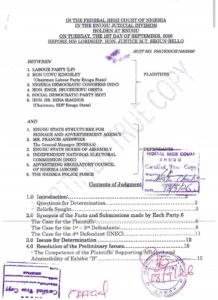
According to a certified true copy (CTC) of the judgment, Justice Mabel Segun-Bello, on September 1, 2026, dismissed key claims brought by opposition political parties and their representatives challenging the agency’s authority to impose the fee.
The judge ruled that outdoor advertising does not fall exclusively within the legislative powers of the National Assembly, adding that the Enugu State House of Assembly was constitutionally empowered to enact laws regulating advertising within the state.
The suit, marked FHC/EN/CS/165/2026, was instituted in June 2026 by the Labour Party (LP), its Enugu State Chairman, Hon. Kingsley Ugwu; the Nigeria Democratic Congress (NDC), its factional state chairman, Engr. Ibuchukwu Obetta; the Social Democratic Party (SDP), and its state chairman, Hon. Magnus Ezea.
The defendants included ENSSAA, its General Manager, Mr. Francis Aninwike; the Enugu State House of Assembly; the Independent National Electoral Commission (INEC); the Advertising Regulatory Council of Nigeria (ARCON); and the Nigeria Police Force.
The plaintiffs had asked the court to declare that Sections 99(1) and 99(2) of the Electoral Act, 2026, and Section 153 of the 1999 Constitution vested exclusive authority in INEC to regulate political campaigns, making ENSSAA’s imposition of the fee unlawful.
They also challenged the legislative authority of the Enugu State House of Assembly to enact laws regulating political campaign advertisements.
Consequently, the plaintiffs sought an order setting aside the ₦150 million fee and restraining ENSSAA, its management, the state government and their representatives from enforcing the directive.
They further requested an order compelling the police to protect political parties from possible harassment over the placement of campaign billboards and posters for local government and 2027 general elections.
However, after considering the affidavit evidence, documentary exhibits and submissions of the parties, Justice Segun-Bello ruled that outdoor advertising was not a matter reserved exclusively for the National Assembly or ARCON.
“I accede to the 1st, 2nd and 3rd Defendants’ contention that the subject matter of ‘outdoor advertising’ is NOT reserved exclusively to the National Assembly or to ARCON,” the judge stated.
She explained that outdoor advertising fell within the primary functions of local governments and could be exercised by a state agency where authority had been validly delegated.
The judge also held that ENSSAA had established that it possessed the delegated authority to issue its February 9, 2026, directive regulating political campaign advertisements.
Consequently, she declared that it was not ultra vires the powers of ENSSAA and its general manager to prescribe a mandatory ₦150 million advertising permit fee as a condition for using billboards in Enugu State.
Justice Segun-Bello further ruled that the state House of Assembly was within its legislative powers to enact laws regulating advertising in the state.
The court also held that the directive requiring political parties and their candidates to pay ₦150 million as a precondition for obtaining permits for campaign billboards and posters for the 2026 and 2027 elections did not constitute an unlawful use of state authority to disadvantage political parties, contrary to Section 99(2) of the Electoral Act, 2026.
The judge, however, refused the plaintiffs’ remaining reliefs that were not expressly granted.
Meanwhile, the Enugu State Government has clarified that the ₦150 million fee applies to each political party rather than individual candidates, contrary to claims circulating on social media and comments by some commentators.
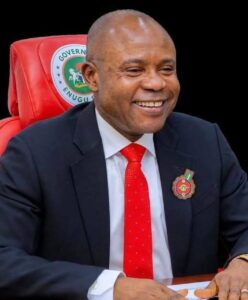
The Secretary to the State Government, Prof. Chidiebere Onyia, reportedly made the clarification while answering questions from Government House correspondents in Enugu. He also dismissed reports that a Federal High Court in Abuja had delivered a judgment nullifying the fee.
How other states structure campaign advertising fees
Available information indicates that other states also impose advertising permit fees on political candidates, although the amounts and payment structures vary.
In Abia State, the Abia State Structures for Signage and Advertising Agency (ABSSAA) reportedly prescribes fees ranging from ₦20 million for House of Assembly candidates to ₦200 million for presidential candidates.
In Imo State, the reported fees range from ₦3.55 million for House of Representatives candidates to ₦55 million for governorship candidates, while another reported fee schedule places charges between ₦300,000 for local government candidates and ₦150 million for presidential candidates.
The campaign permit fees in another reported schedule range from ₦100,000 for councillorship candidates to ₦50 million for presidential candidates.
Kwara State, meanwhile, reportedly charges ₦2 million for House of Assembly candidates and ₦100 million for presidential candidates.
The Enugu judgment is expected to shape further discussions on the respective powers of state advertising agencies and electoral authorities in regulating political campaign materials ahead of the 2027 general elections.