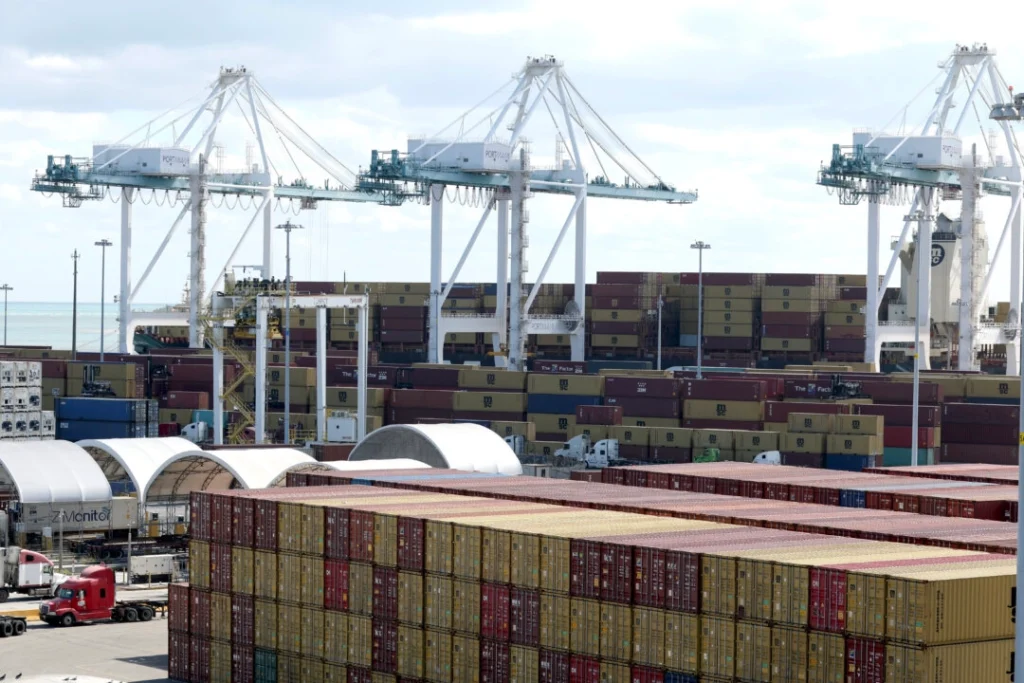
President Donald Trump’s newly announced global tariff regime took effect at 12:01 a.m. on Feb. 24 at a rate of 10 percent, following a proclamation issued under Section 122 of the Trade Act of 1974, despite a weekend statement indicating the rate would be raised to 15 percent.
The implementation follows a landmark ruling by the Supreme Court of the United States last week that the International Emergency Economic Powers Act (IEEPA) does not authorize the president to impose tariffs on U.S. trading partners. The decision invalidated a broad range of import duties previously enacted under IEEPA, including the reciprocal tariffs introduced in April 2025.
In response, President Trump issued a Feb. 20 proclamation invoking Section 122 authority, which permits the imposition of tariffs of up to 15 percent for 150 days to address “large and serious balance-of-payments deficits.” Any extension beyond that period would require congressional approval.
In a Feb. 21 post on Truth Social, the president said he would immediately raise the global tariff rate from 10 percent to the “fully allowed, and legally tested, 15% level.” As of midnight Feb. 24, however, no formal directive had been issued to enact the higher rate.
Late Feb. 23, U.S. Customs and Border Protection (CBP) notified importers that the 10 percent tariff would apply to “imported articles of every country for a period of 150 days, unless specifically exempt.” In a separate bulletin, CBP confirmed that tariffs previously implemented under IEEPA authority would cease to be collected as of the same deadline.
The new tariff framework includes several exemptions, including goods compliant with the United States–Mexico–Canada Agreement (USMCA), as well as pharmaceuticals, critical minerals, and certain food imports.
Other sector-specific duties remain unchanged, including 50 percent tariffs on aluminum, copper products, and steel; 25 percent tariffs on automobiles and furniture; and 10 percent tariffs on lumber.
President Trump also signaled potential escalation, warning Feb. 23 that countries seeking to revisit or withdraw from trade agreements could face higher duties. The statement followed reports that the European Parliament halted ratification proceedings on U.S.–European Union trade arrangements, citing concerns that a 15 percent tariff would conflict with terms agreed upon last summer.
Administration officials said foreign governments have sought clarification but have not withdrawn from negotiated commitments. U.S. Trade Representative Jamieson Greer told CBS’s “Face the Nation” on Feb. 22 that partners are expected to uphold their agreements, adding he had not been informed of any country declaring a deal void.
Tariff Refund Uncertainty
The Supreme Court’s ruling has triggered significant uncertainty regarding potential refunds for duties previously collected under IEEPA.
Economic analysts estimate the total value of refund claims could be substantial. The Penn Wharton Budget Model projects that tariff refunds may reach $175 billion, raising concerns among market participants about short-term federal financing pressures.
Jeff Buchbinder, chief equity strategist at LPL Financial, noted that any large-scale refund issuance could require near-term Treasury financing, potentially affecting the yield curve.
Administration officials have indicated that refund processing may be delayed pending further judicial guidance. Greer stated that clarification may be required from the U.S. Court of International Trade regarding eligibility and procedural requirements for claims.
Corporate litigation is already underway. FedEx filed suit against the federal government on Feb. 23, seeking a full refund of IEEPA-related duties paid last year. The company joins a growing number of firms pursuing reimbursement, including major retailers and consumer brands that have initiated legal action in recent months.
As legal proceedings unfold and international partners assess the implications of the court’s decision, businesses and policymakers alike face ongoing uncertainty over the scope and durability of the administration’s revised tariff strategy.