
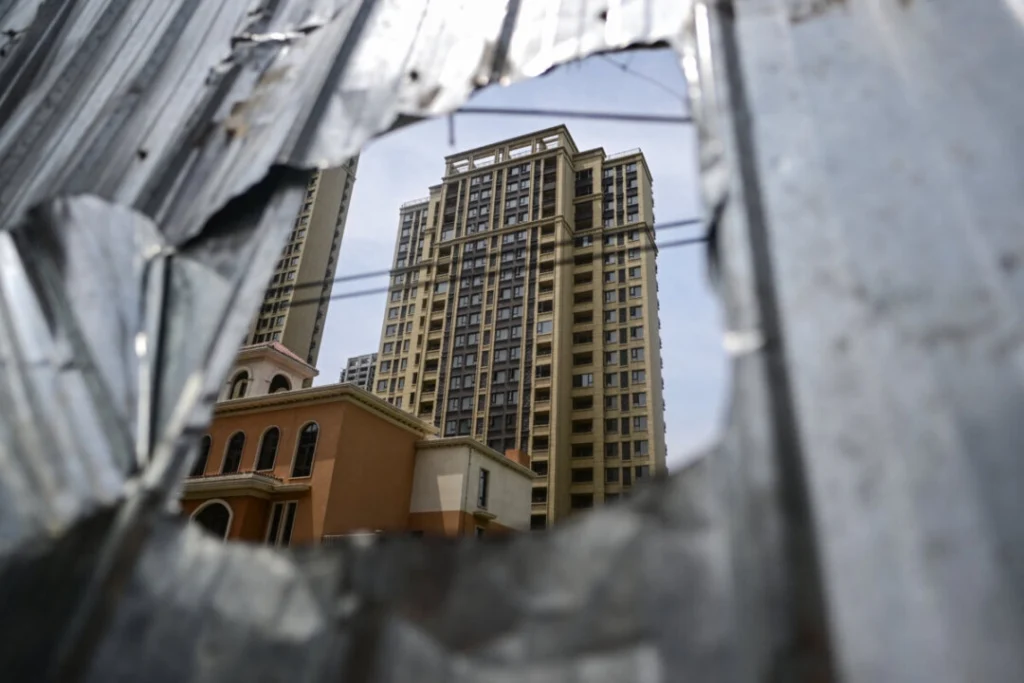
A well-known Chinese real estate commentator recognized for his bearish outlook on the nation’s housing market has been permanently banned from Douyin, China’s version of TikTok, fueling renewed debate over online speech restrictions as the country’s property downturn persists.
The blogger, who operated under the name “Yi Lu Xiang Bei,” had amassed more than 1 million followers and built a reputation for repeatedly cautioning that home prices would continue to decline. In a series of widely viewed videos, he urged followers to “de-real-estate” their portfolios, arguing that holding cash would offer greater security than property in the coming years.
His Douyin account was suspended on Feb. 17, the first day of the Lunar New Year. Chinese outlet NetEast and several independent X accounts reported the move. Douyin has not publicly specified the reason for the permanent ban.
Observers say his frequent projections of further price declines may have been interpreted as undermining confidence in the economy, potentially crossing regulatory lines amid heightened scrutiny of economic commentary online.
The suspension has prompted concern among some Chinese internet users who question whether discussion of economic headwinds is being increasingly curtailed.
A netizen surnamed Huang told The Epoch Times that the ban itself was more troubling than the blogger’s market stance.
“In recent months, there have been noticeably fewer posts about falling home prices, restaurant closures, or shops shutting down,” Huang said. “It feels like the vast majority of that content is being filtered out. Even indirect pessimistic commentary is quickly flagged.
Many people have stopped talking about it altogether.”
China’s property sector remains a cornerstone of the national economy, accounting for a significant share of household wealth and local government revenue.
Some legal analysts argue that both positive and negative market views should be permitted as part of a healthy public discourse.
A lawyer in Henan Province surnamed Chen said limiting pessimistic perspectives could disadvantage prospective homebuyers.
“Consumers need access to a range of opinions to understand real market trends,” Chen said. “Optimistic or pessimistic, online commentary represents personal views. The public can decide what to believe.”
The ban comes amid broader efforts to tighten oversight of economic narratives online. In September, state media outlet People’s Daily reported that authorities were targeting content that “maliciously provokes negative emotions.”
Since then, online videos depicting empty commercial districts or slowing consumer activity have become less common.
Archived clips of “Yi Lu Xiang Bei” show him frequently addressing property trends, household financial risks, and macroeconomic shifts during livestreams.
He warned that home prices could face prolonged declines, secondhand listings were rising, corporate profit margins were narrowing, and income growth was becoming more challenging for ordinary citizens.
A China-based independent scholar told The Epoch Times that the issue reflects broader tensions between market realities and political messaging.
“In the current information environment, the determining factor is not only factual accuracy but whether the message aligns with broader policy objectives,” the scholar said. “Public access to information has always operated within defined boundaries.”
The scholar noted that real estate plays a pivotal role in China’s fiscal framework, with local governments heavily reliant on land sales for revenue. A sustained housing slump could further strain municipal finances and pressure property developers.
Meanwhile, official data indicate the housing market remains under pressure. According to the National Bureau of Statistics, prices of new and existing homes across 70 major cities in January extended month-over-month declines, with authorities describing the sector as undergoing a “deep adjustment cycle.”
In top-tier cities, new home prices fell 0.3 percent from the previous month, while existing home prices dropped 0.5 percent. On a year-over-year basis, secondhand home prices in Shanghai, Beijing, Guangzhou, and Shenzhen declined between 6.8 percent and 8.7 percent. Smaller cities also reported continued price weakness.
The removal of one of the country’s most prominent bearish housing commentators underscores the sensitivity surrounding public discussion of the property downturn, as the sector continues to weigh on China’s broader economic outlook.