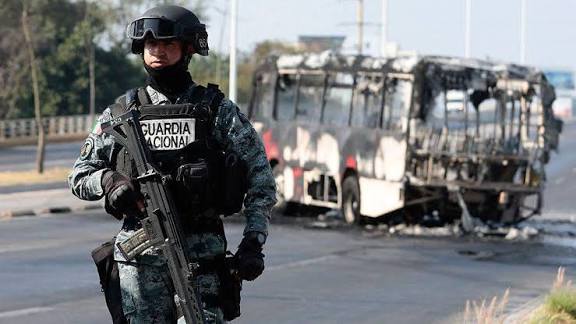
At least 25 members of Mexico’s National Guard were killed in a wave of coordinated attacks in the western state of Jalisco following the death of alleged cartel leader Nemesio Oseguera Cervantes, known as “El Mencho,” authorities confirmed Monday.
Mexico’s Security Secretary Omar Garcia Harfuch announced the toll during a joint morning press conference with President Claudia Sheinbaum, describing the violence as retaliation for a federal operation that resulted in Oseguera Cervantes’ death on Sunday.
According to Garcia Harfuch, six separate attacks targeted security forces in Jalisco. In addition to National Guard personnel, a prison guard, an agent from the state prosecutor’s office, and an unidentified woman were also killed. Authorities reported that approximately 30 suspected criminals were killed in Jalisco and four more in neighboring Michoacán during security operations.
Garcia Harfuch said El Mencho’s death triggered “27 cowardly attacks against authorities in Jalisco,” and confirmed that at least 70 individuals have been arrested across seven states in connection with the unrest.
“We are closely monitoring for any kind of reaction or restructuring within the cartel that could lead to violence,” he said.
The White House confirmed Sunday evening that the United States provided intelligence support to Mexico ahead of the operation targeting Oseguera Cervantes, who led the Jalisco New Generation Cartel (CJNG).
White House press secretary Karoline Leavitt said in a post on X that three additional cartel members were killed, three wounded, and two arrested during the raid, and praised Mexican forces for dismantling one of the most wanted criminals in both countries.
In response to the surge in cartel-related violence, the United States Embassy in Mexico announced that personnel in multiple cities would shelter in place and operate remotely on Monday. The embassy also advised U.S. citizens in affected areas to remain indoors and exercise heightened awareness.
Following confirmation of El Mencho’s death, cartel operatives launched retaliatory actions across parts of Mexico, blocking highways, torching vehicles, and setting fire to buildings. Gunfights with security forces were reported in several municipalities.
The CJNG, founded in 2009, has been identified by U.S. authorities as one of Mexico’s fastest-growing and most violent criminal organizations.
The U.S. State Department had previously offered a reward of up to $15 million for information leading to Oseguera Cervantes’ arrest and conviction. In 2025, the administration of President Donald Trump designated the CJNG and other major Mexican cartels as foreign terrorist organizations amid ongoing concerns over fentanyl trafficking and cross-border violence.